Get free quotes from environmental site assessment near you
Takes about a minute. Free, no obligation; providers reply to you directly.
A developer I know spent six months on a brownfield acquisition — Phase II ESA ordered, groundwater samples sent to the lab, the whole process — only to find out at closing that the environmental firm he’d hired had assigned his project to a junior analyst who’d never written a report solo. The partner who sold him on the engagement? Hadn’t touched the file once. The report had three factual errors about the site’s regulatory history that his lender flagged, and they had to pay for a supplemental review.
He could have hired a solo consultant for a third of the price and gotten the senior professional’s eyes on every page.
The Short Version:For most Phase I ESAs and straightforward compliance work, a credentialed freelance environmental consultant will cost less, start faster, and deliver more senior-level attention than a mid-tier agency. Hire an agency when your project genuinely needs a team — multiple concurrent workstreams, multi-site programs, or a lender who requires an E&O-insured firm by name.
Key Takeaways:
- Freelance consultants typically start in under a week; agency proposals can take weeks to scope and contract
- Agencies carry higher overhead (staff, office, admin) that flows directly into your invoice
- Solo consultants stake their entire professional reputation on each report — that creates accountability agencies can’t replicate
- Project complexity is the real deciding factor, not brand recognition
What You’re Actually Buying
Here’s what most people miss: when you hire an environmental consulting firm, you’re not automatically getting a senior professional. You’re buying access to a firm’s bench, and whether a principal or a two-year analyst writes your Phase I depends entirely on your project’s billing priority that week.
A freelance consultant — typically a CHMM, REP, PE, or PG operating independently — is the senior professional. There’s no junior staff to delegate to. Every records review, every site reconnaissance, every ASTM E1527-21 checklist item goes through one credentialed set of hands: theirs.
That’s not always an advantage. But for a single-site Phase I or a targeted compliance review, it usually is.
The Honest Comparison
| Factor | Freelance Consultant | Environmental Agency |
|---|---|---|
| Cost | Lower — no office/admin overhead baked in | Higher — team, overhead, and margin all on the invoice |
| Time to start | Often under 1 week | Weeks to months for scoping and contracting |
| Who does the work | The person you hired | Whoever’s available on the bench |
| Scalability | Limited to one professional’s bandwidth | Can staff up for multi-site programs |
| Contracts | Flexible, task-based | Formal, often retainer or lump-hour |
| E&O insurance | Varies — must verify | Standard for established firms |
| Accountability | Direct — their reputation is on every page | Diffuse — managed through project manager |
| Regulatory relationships | Varies by individual | Broader in large firms with state/federal contacts |
When Freelance Makes Sense
Single-site Phase I for acquisition or lender due diligence. This is the freelance consultant’s home turf. ASTM E1527-21 is a defined scope — records review, site reconnaissance, interviews, REC identification. A solo CHMM with 15 years of regional experience will do this faster and cheaper than a firm charging you for project management overhead on top of the technical work.
Budget is a real constraint. Freelancers undercut agencies by eliminating administrative and personnel expenses that don’t add value to your report. For a developer doing multiple acquisitions a year, that delta adds up.
You want the same professional every time. If you’re building a relationship with someone who understands your portfolio, your lenders’ requirements, and your risk tolerance, a freelancer who treats you as a long-term client is a fundamentally different arrangement than rotating through whoever a firm assigns.
Pro Tip:Ask any prospective consultant — freelance or agency — to name the specific individual who will conduct the site visit and sign the report. If they hedge, that’s your answer.
When an Agency Makes Sense
Multi-site programs or portfolio work. One consultant has one set of hands. If you’re closing on a 12-property portfolio with staggered deadlines, you need a firm that can staff multiple assessments concurrently.
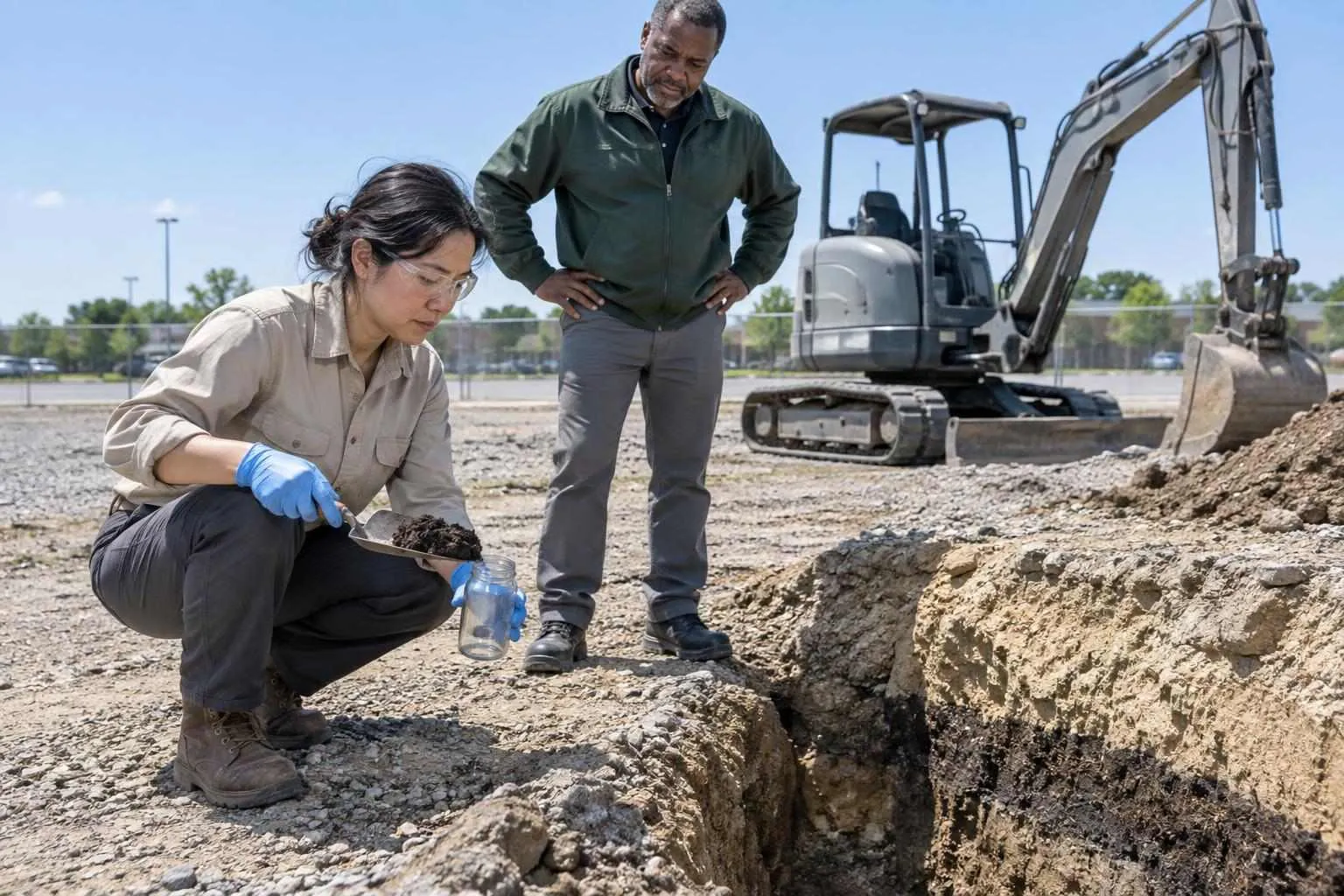
Phase II investigations with specialized subcontractors. Soil borings, groundwater monitoring wells, laboratory coordination, remediation oversight — this work often requires a team with established subcontractor relationships and the logistics infrastructure to manage them. A solo consultant can oversee a Phase II, but verify their network before assuming they can.
Lender requirements specify firm credentials. Some CMBS and SBA lenders require E&O insurance minimums or known firm names on ESA reports. Check your lender’s approved vendor requirements before you hire anyone.
You need a defensible paper trail for litigation. Large firms have documented QA/QC processes, institutional backing, and insurance that can matter if a report gets challenged.
Reality Check:“We’re a full-service environmental firm” is not a credential. CHMM, REP, PE, PG — those are credentials. A 50-person agency staffed with non-credentialed analysts is less qualified than one credentialed solo consultant. Check the individual, not the logo.
The Price vs. Reliability Trade-Off (Honestly)
I’ll be honest: the freelance risk is real. A solo consultant who gets sick, overcommits, or has a personal crisis mid-project creates a problem with no backup. Agencies absorb that risk institutionally — someone else picks up the file.
The mitigation is vetting. Platforms like Leafr match clients with sustainability and environmental freelancers quickly, but references and project history matter more than platform ratings. Ask for three recent Phase I reports they’ve written. Read the regulatory history sections. You’ll know immediately if you’re dealing with a seasoned professional or someone who’s competent on paper but rough in practice.
On the agency side, the risk is opacity. You can vet the firm’s reputation without ever knowing who will actually do your work. Negotiate for named personnel in the contract if the engagement matters.
Practical Bottom Line
Hire a freelance environmental consultant if: You have a defined scope (Phase I, compliance review, single-site), cost efficiency matters, and you want a credentialed senior professional’s direct attention on your project.
Hire an agency if: You need parallel capacity, a Phase II with complex logistics, or your lender requires it.
Either way, your checklist before signing anything:
- Confirm the specific credentialed professional who will conduct and sign the work
- Verify E&O insurance coverage — freelancers should have it, but confirm the limit
- Ask for a sample report from a comparable project in your state
- Get the timeline in writing, with milestone dates
For a deeper foundation on what environmental consultants actually do and how the ESA process works, start with The Complete Guide to Environmental Consultants before you contact anyone.
The best consultant for your project is the one who shows up, knows ASTM E1527-21 cold, and has their name on the line. Sometimes that’s a firm. Often it’s one very good person working for themselves.
Done reading? Get quotes from environmental consultants near you.
Takes about a minute. Free, no obligation; providers reply to you directly.
Popular cities:
Nick built this directory to help developers and lenders find credentialed environmental consultants without wading through firms that also perform remediation — a conflict of interest he encountered firsthand while navigating due diligence on a commercial acquisition.